Imagine your SDR spends two full weeks on highly personalized outreach for an account that will at most bring in €8,000 in ARR. At the same time, your potentially largest deal - an enterprise customer with €80,000 potential - is just sitting in a generic email sequence. That is not an edge case. That is daily reality in most B2B tech companies before they introduce a clear ABM tier structure for their linkedin lead generation and linkedin b2b outreach.
Account based marketing at its core means: focus your resources where the potential value is highest. That requires a clear prioritization of your accounts, structured into tiers.
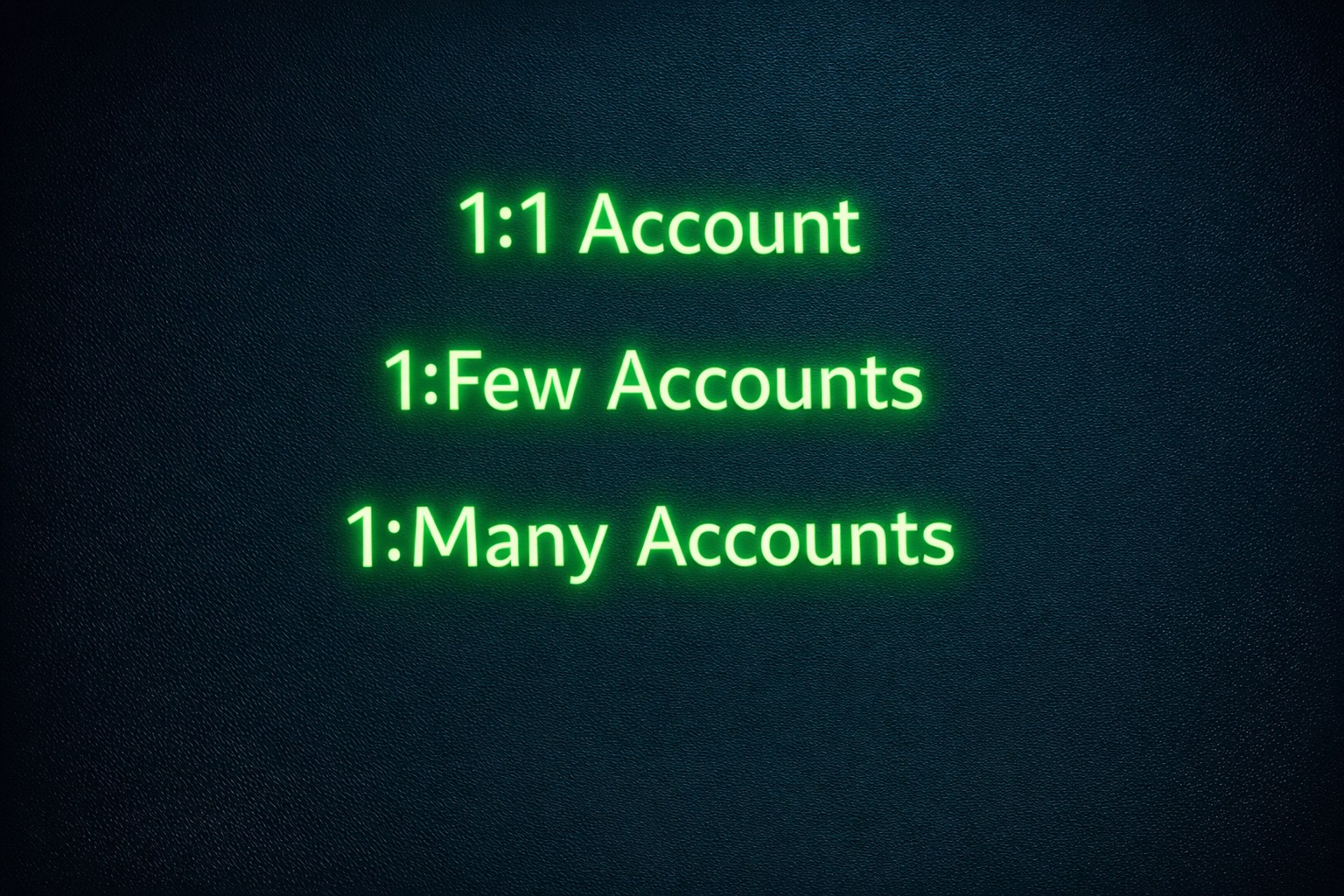
In this guide, you will learn how to build the three ABM tiers (1:1, 1:Few, 1:Many) for your B2B tech company in the DACH region in a concrete way: with recommended account volumes, cadence, KPIs, tools and anonymized real-world examples that tie directly into your b2b sales strategy and linkedin sales strategy.
What Is an ABM Tier Structure - And Why Is It Not Just an Enterprise Concept?
ABM is not an enterprise luxury. The tiering logic works for every B2B tech company from roughly 10K ARR deal size — as long as you prioritize your accounts and align resource deployment with the potential.
The classic ABM tier logic comes from the enterprise world. But the underlying principle is relevant for every B2B tech company in the DACH region: b2b abm performs best when resources are allocated based on value potential. Not every account needs the same level of attention - tiered b2b customer segmentation lets you distribute effort deliberately across 1:1, 1:Few and 1:Many. Each tier gets the degree of personalization that matches its strategic value.
The result: the most effective programs run all three ABM tiers as a pyramid - a small 1:1 tier at the top, a larger 1:Few tier in the middle, and a broad 1:Many base that warms up your entire addressable market and supports scalable b2b tech lead generation.
Important: ABM is not an alternative to outbound - it is the logical next step. If you already work with b2b tech ideal customer profile (ICP) clusters, trigger-based messaging and LinkedIn + email sequences, you are essentially already doing account based marketing - just without using the label.
Overview: The Three Tiers at a Glance
| Feature | Tier 1 - 1:1 | Tier 2 - 1:Few | Tier 3 - 1:Many |
|---|---|---|---|
| Number of Accounts | 10-20 | 20-50 | 100-500 |
| Ideal Deal Size (ARR) | > 50.000 € | 10.000-50.000 € | < 10.000 € |
| Level of Personalization | Fully personalized | Cluster-specific | Data-driven, automated |
| LinkedIn Approach | CEO/Founder Outreach, Custom Content | Sequences by Industry/Pain Point | LinkedIn Ads + Automated Outreach |
| Effort Required | High (3-5h/account/week) | Medium (1-2h/account/week) | Low (< 30 min/account/week) |
| Sales Cycle | 60-180 days | 30-90 days | 7-30 days |
| Key KPIs | Meeting Rate, Pipeline Velocity, Deal Size | Response Rate, MQL-to-SQL Rate | CTR, Reply Rate, Cost per Lead |
| Recommended Tools | Sales Navigator, Clay, Custom Landing Pages | Clay, HubSpot, LinkedIn Sequences | LinkedIn Ads, Apollo, Automated Sequences |
Tier 1 - 1:1 ABM: Fully Individualize the Top 10-20 Accounts
When Is Tier 1 the Right Approach?
Tier 1 is reserved for accounts that can truly move your pipeline. Typically: deals with high ACV, long sales cycles, complex stakeholder environments and significant implementation scope. They require executive attention on both sides - there is zero room for generic engagement.
Rule of thumb for the DACH region: every account with realistic ARR potential above €50,000 belongs in Tier 1.
What "Fully Individualized" Actually Means
In Tier 1 ABM, personalization is structural. Messaging is not just slightly adapted - it is built around the account's operating model, competitive situation, strategic priorities and internal initiatives. Marketing develops custom content aligned with the company's specific growth agenda, while Sales builds executive relationships early. This is the sharp end of your linkedin b2b sales process.
Concretely, for LinkedIn:
- The founder/CEO runs the outreach personally - not delegated to an SDR
- Individual research into current initiatives, hiring signals, product changes
- Optional: personalized landing page or short video created specifically for this account
- Buying committee mapping: who decides, who influences, who blocks?
Practical Example (Anonymized): SaaS Company for Compliance Software
A German SaaS company with 30 employees identifies 15 enterprise accounts in financial services and insurance. For each account, a dedicated "account plan" is created: current compliance challenges, which decision-makers are active on LinkedIn, and which specific pain point can serve as the entry point for a conversation. The CEO personally runs the linkedin b2b outreach - including personalized voice notes responding to a recent post by the target contact. Result: 6 out of 15 accounts book a meeting within 8 weeks.
KPIs for Tier 1
| KPI | Target Value |
|---|---|
| Meeting booking rate | 20-40% of contacted accounts |
| Deal progression (stage advancement) | At least 60% after first contact |
| Pipeline velocity | ≤ 90 days to opportunity stage |
| Average ACV | > €50,000 |
Recommended Cadence
- Week 1: Account research, buying committee mapping, LinkedIn profile warm-up (follow, like, comment)
- Week 2: Personalized connection request + first message (CEO level)
- Week 3-4: Follow-up with custom insight or a concrete use case
- From week 5: Parallel outreach to additional stakeholders in the buying committee
Tier 2 - 1:Few ABM: Target Clusters of 20-50 Accounts by Industry
When Is Tier 2 the Right Approach?
Tier 2 occupies the middle ground between one-to-one outreach and scaled outreach. Instead of treating every account as a stand-alone case, accounts are grouped based on vertical segmentation, regulatory pressure, technological maturity or use case targeting - defined by observable patterns, not gut feeling. This is where structured b2b customer segmentation and a focused abm strategy begin to scale.
Rule of thumb for the DACH region: deals between €10,000 and €50,000 ARR where you have similar companies in the same industry or with comparable pain points.
What "Cluster-Specific" Actually Means
In Tier 2 ABM, the core value proposition within each segment stays consistent, but examples, proof points and context are tailored to the shared reality of that cluster. Content includes industry-focused webinars, semi-individual landing pages, tailored email sequences and targeted social engagement that speaks directly to common challenges. This is often where saas lead generation Germany programs become clearly profitable.
A Tier 2 cluster could look like this:
- Cluster A: HR tech SaaS providers in the DACH region, 50-200 employees, focusing on remote work compliance
- Cluster B: FinTech scale-ups post-Series A that are currently hiring a Head of Sales
- Cluster C: Consulting agencies shifting from project-based business to productized SaaS models
Each cluster gets its own LinkedIn sequence, its own email drips and its own messaging - but within the cluster, communication is not individualized per account.
Practical Example (Anonymized): B2B SaaS for Digital Onboarding
A Munich scale-up segments its 200 target accounts into four clusters by industry and company size. For each cluster, a 5-step LinkedIn sequence is built: Step 1 addresses the specific pain (for example, "onboarding drop-offs in financial services"), Step 3 delivers an industry case study, Step 5 is a direct call to action. In parallel, email drips run with 3 touchpoints. Result: a 12% meeting rate across all clusters - with around 1.5 hours of effort per account, supported by targeted b2b outbound tools.
KPIs for Tier 2
| KPI | Target Value |
|---|---|
| Reply rate (LinkedIn) | 15-25% |
| MQL-to-SQL conversion | > 30% |
| Meeting booking rate | 8-15% |
| Cost per meeting | €150-400 |
Recommended Cadence
- Week 1: Finalize cluster segmentation and messaging per cluster
- Week 2: Launch LinkedIn sequence (connection request + first message)
- Week 3: Follow-up message + activate email drip
- Week 4-6: Two additional touchpoints, A/B test between messaging variants
The cleanest foundation for this is a precise ICP cluster logic for your b2b tech ideal customer profile - as described in detail in the guide on Multi-Touch-Point Journeys in B2B Sales.
Tier 3 - 1:Many ABM: Target 100-500 Accounts in a Data-Driven Way
When Is Tier 3 the Right Approach?
Tier 3 is built for scale - but scale does not mean dilution. Accounts are still pre-defined and targeting remains account-specific. The difference lies in the execution model and the degree of personalization.
Rule of thumb for the DACH region: deals below €10,000 ARR, or an expansion strategy for existing customers. Tier 3 is also a good entry point for b2b outbound Germany programs to identify accounts that should be promoted into Tier 2 or Tier 1.
What "Data-Driven and Automated" Actually Means
Tier 3 depends on two ingredients: a clean account list and buying signals. At any given time, only about 5% of your target market is actively in a buying process. The consequence: you cannot just target based on fit - you have to target based on buying readiness. That means using buying signals and intent data to identify accounts with active interest.
Relevant buying signals for the DACH market:
- LinkedIn activity: new sales or marketing hires
- Funding events: Series A/B financing rounds
- Technology signals: implementation of a new CRM or sales tool
- Hiring patterns: job postings for specific roles
Outreach runs through automated LinkedIn sequences + email drips, complemented by LinkedIn Ads as an awareness layer for accounts that have not yet responded to direct outreach. This creates a scalable foundation for linkedin lead generation and a repeatable linkedin b2b sales process.
Practical Example (Anonymized): IT Consultancy Expands into New Verticals
An IT consultancy based in Hamburg with 80 employees wants to expand into new vertical markets. They build a list of 350 accounts in three new industries - filtered by company size, tech stack and LinkedIn activity. For each industry, there is an automated 4-step sequence (LinkedIn + email). Accounts that respond or visit profiles are promoted into Tier 2 clusters. Result: a 4.5% meeting rate across 350 accounts, with 8 of them directly promoted to Tier 2.
KPIs for Tier 3
| KPI | Target Value |
|---|---|
| Email open rate | 35-50% |
| LinkedIn reply rate | 5-12% |
| CTR (LinkedIn Ads) | 0.6-1.2% |
| Cost per lead | €30-100 |
| Accounts upgraded to higher tiers | 5-10% of the total list |
Recommended Cadence
- Week 1-2: Build the account list and enrich it with buying signals (for example via Clay or Apollo)
- Week 3: Activate automated sequences (LinkedIn + email in parallel)
- Week 4-8: Run LinkedIn Ads in parallel for accounts without reactions
- Ongoing: Account scoring and decisions on tier upgrades
The ABM Pyramid Model: How All Three Tiers Work Together
The three tiers are not alternatives - they form a system. Tier promotion (1:Many -> 1:Few -> 1:1) happens when accounts show engagement and intent.
In practice, that means:
- Tier 3 is the prospecting net: broad targeting identifies who reacts at all
- Tier 2 is the qualification layer: cluster-specific messaging separates buying-ready from not-yet-ready accounts
- Tier 1 is the closing layer: fully individualized effort for accounts with real enterprise potential
This is also why an ABM strategy does not require huge upfront budgets. You start with Tier 2 or Tier 3, validate the methodology, and then invest selectively in Tier 1 once you know which accounts have the potential.
Find Your Right ABM Tier: Interactive Selector
Not sure which tier to start with? The selector below helps you make the right decision based on your deal size, buying committee size and available resources.
Leadtree's Approach: Done-for-You Across All Three Tiers
The most common question we hear from founders and heads of sales in the DACH region: "ABM sounds good - but who actually executes it?"
That is the key difference between enterprise ABM platforms and the Leadtree approach. According to 2026 benchmarks, Tier 1 ABM costs €50,000-250,000 per account per year in marketing spend - not including sales compensation. Tier 2 ABM runs at €5,000-25,000 per account annually, while Tier 3 typically remains under €1,000 per account. Enterprise ABM platforms like 6sense and Demandbase often cost €50,000-250,000 per year.
Leadtree delivers done-for-you execution for all three ABM tiers - with no minimum contract term, no setup fee, and monthly cancellation. Concretely, for your linkedin b2b outreach and b2b outbound Germany activities:
- Tier 1: full account research, individual messaging, CEO outreach on LinkedIn and buying committee mapping
- Tier 2: ICP cluster segmentation, industry-specific sequences (LinkedIn + email), A/B testing
- Tier 3: automated outreach sequences, account scoring, buying signal identification via a tech stack of more than 18 b2b outbound tools
The crucial benefit: you do not have to build the methodology yourself. Leadtree takes over the entire communication up to meeting booking - with transparent KPI reporting and dashboards you can access at any time. This setup supports consistent linkedin lead generation while preserving quality through personalized outreach sequences.
Real example: Node Energy booked 11 qualified meetings and gained 300 new relevant contacts in the first month - with a Tier 2 approach on LinkedIn, operated by Leadtree as part of a focused B2B tech lead generation program.
You can find more on how to scale your LinkedIn sales activities without losing quality in the guide on Social Selling vs. LinkedIn Ads - including an honest cost comparison and implications for your linkedin sales strategy.
The 5 Most Common Mistakes When Building ABM Tiers
Putting too many accounts into Tier 1. You cannot truly individualize more than about 20 accounts. If you label 50 accounts as "Tier 1," you effectively have Tier 2 - just with higher effort and lower quality.
Running Tier 3 as spray-and-pray. Programmatic ABM is the approach most teams start with - but it is also the one that fails most often when the account list is wrong. Without intent data and close sales orchestration, it degrades into expensive retargeting.
Not defining an upgrade path between tiers. An account that reacts to Tier 3 outreach must automatically be promoted to Tier 2. If that mechanism is missing, qualified accounts will slip through the cracks.
Ignoring buying committees. An average B2B deal involves around seven decision-makers or influencers - slightly more than a few years ago, reflecting stronger cross-functional input. You cannot just add "Acme Corp" to your target account list - you need all relevant personas within the company mapped into your linkedin b2b sales process.
Not defining tier-specific KPIs. If you evaluate Tier 1 accounts based on cost per lead, you will always be disappointed. Tier 1 is measured by pipeline velocity and deal size - not volume metrics.
Decision Matrix: Which Tier Fits Your Situation?
| Situation | Recommended Tier Entry Point |
|---|---|
| First enterprise target identified, deal > €50k ARR | Tier 1 for top 5 accounts, Tier 2 for the rest |
| Growth phase after Series A, clear target industry | Tier 2 as primary tier, Tier 3 as pipeline feeder |
| Early stage / pre-seed, deal size < €15k, ICP not yet validated | Tier 3 for testing, then Tier 2 once patterns emerge |
| First enterprise deals won but not yet repeatable | Tier 1 for known accounts, Tier 2 for similar profiles |
| Head of Sales hired, need to scale sales | All three tiers in parallel, Tier 3 as sourcing layer |
Conclusion: ABM Tiers Are Smart Resource Allocation, Not Overhead
The ABM tier structure is not a bureaucratic extra layer. It is the answer to a simple question: where do we invest our limited sales time for the highest ROI?
For B2B tech companies in the DACH region, that means in concrete terms:
- Tier 1 for the 10-20 accounts that can truly shift your pipeline
- Tier 2 for industry-specific clusters that can be qualified efficiently
- Tier 3 as a data-driven awareness base and upgrade feeder for the other tiers
You do not need an enterprise budget or a complex ABM platform to get started. You need a clearly defined ICP, a prioritized account list - and the discipline to not treat every account the same. From there, you can align your abm strategy closely with your linkedin b2b sales process and broader b2b sales strategy.
If you are already working with structured LinkedIn outreach and multi-channel outbound, you already have the foundation. The ABM tier model is simply the next logical step to professionalize your linkedin lead generation and saas lead generation Germany efforts.
Do I need to operate all three tiers at the same time?
No - and that would not be sensible for most startups either. A phased approach is recommended: Start with Tier 2 (1:Few) for 20-50 prioritized accounts to validate the model. When you close your first enterprise deals, move the top-5 accounts to Tier 1. Tier 3 will then be introduced in parallel as an awareness base.
At what company size does ABM make sense?
ABM can be used effectively starting from a small sales team (1-2 people) - provided you have a clearly defined ICP and accounts with a deal size of at least €10,000 ARR. Below this threshold, classic outbound is often more efficient.
How long does it take for ABM results to show?
Tier 3 often yields first responses after 2-4 weeks. Tier 2 typically takes 6-12 weeks to the first qualified meetings. Tier 1 is a longer game: plan 3-6 months until the first deal - but with significantly higher ACV.
How does Leadtree's approach differ from classic ABM platforms like Demandbase?
Classic ABM platforms like Demandbase or 6sense are designed for enterprise budgets (€50,000-€250,000+ per year) and require internal teams for setup and operation. Leadtree delivers Done-for-You execution for all three tiers: no minimum contract term, no setup fee, and can be canceled monthly — this is ABM quality at startup-friendly terms.
What are the most common mistakes when building ABM tiers?
The three biggest mistakes: (1) packing too many accounts into Tier 1 and sacrificing the quality of personalization. (2) using Tier 3 as a spray-and-pray channel rather than targeting accounts specifically. (3) not defining a clear upgrade path — when an account moves from Tier 3 to Tier 2 should be decided data-driven.